









Paddy Power
Bet €5 get €40
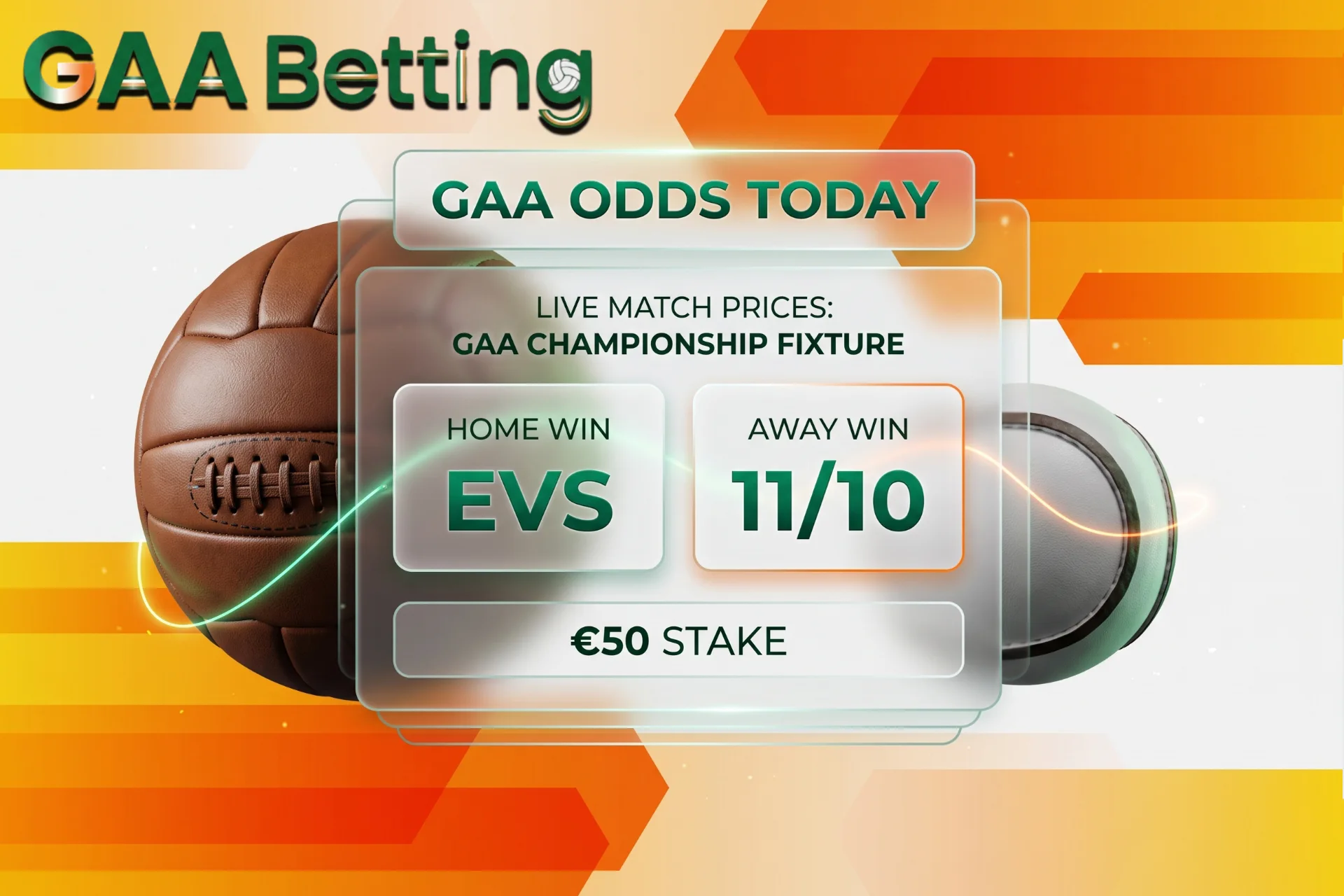
A 6/4 shout, a 2.50 tap on the app and a +150 line all describe one identical wager. Learn to read GAA betting odds in every format, spot a generous price for a Croke Park clash in seconds, and know your return before the ball is thrown in.
Claim Bet €5 Get €40Five licensed Irish operators that price every round of the football and hurling calendar sharply, ranked by Chris Walsh's line-tracking data.
Bet €5 get €40
Bet €10 get €40
Bet €10 get €30
Bet €5 get €30
Bet €10 get €40
| Bookmaker | Welcome offer | Football markets | Hurling markets | Score |
|---|---|---|---|---|
| Paddy Power | Bet €5 get €40 | Extensive | Extensive | 9.8 |
| BoyleSports | Bet €10 get €40 | Extensive | Strong | 9.6 |
| bet365 | Bet €10 get €30 | Strong | Strong | 9.4 |
| Ladbrokes | Bet €5 get €30 | Strong | Good | 9.1 |
| William Hill | Bet €10 get €40 | Good | Good | 8.9 |
Keep this cheat sheet handy when switching between a shop docket and a betting app.
| Fractional | Decimal | Moneyline | Implied % |
|---|---|---|---|
| 1/2 | 1.50 | -200 | 66.7% |
| Evens | 2.00 | +100 | 50.0% |
| 6/4 | 2.50 | +150 | 40.0% |
| 9/4 | 3.25 | +225 | 30.8% |
| 14/1 | 15.00 | +1400 | 6.7% |
Shop boards across the country still chalk prices as fractions, while most apps let you flip to decimals in the account settings.
A bigger decimal number always means a bigger payout, which makes side-by-side bookmaker checks much faster.
Moneyline figures appear mostly on US-facing platforms, but understanding them means no price ever confuses you.
Three hands-on tools to sharpen how you read Gaelic football and hurling prices.
Pull the lever: all three reels land on the same price in each format. Enter a stake to see your return.
Not sure where to start comparing? Spin to land on a bookmaker and see its new-customer deal.
Simulate market moves on sample fixtures. Hot means shortening, cold means drifting.
Every price beside a Gaelic football or hurling fixture does two jobs at once. GAA betting odds tell you how much you will be paid if your selection wins, and they also show how likely the bookmaker thinks that outcome is. Whether the number reads 6/4, 2.50 or +150, it is the same price written in three different formats. Once you can read all three, you can compare bookmakers quickly, tell when a price is short or generous, and know exactly what you stand to win before you place a bet.
Irish punters have a particular relationship with odds. Fractional prices have been chalked on boards in Irish betting shops for generations, and a few decades ago the only place to find a price for a county championship match was the sports pages of a newspaper or a phone call to the local bookie. Today most bets are struck on apps and betting sites, where decimal odds are common and a toggle in the account settings switches between formats. The maths underneath hasn't changed, but the way it is presented has, and that is why understanding every format matters.
Every fixed-odds bet involves three figures. The stake is the amount you risk. The odds describe the price agreed when the bet is struck. The return is what you receive if the bet wins. Some formats show your profit, which is winnings excluding your stake, and others show your total return, which is profit plus stake. Mixing up the two is the most common mistake new punters make, and it is the main difference between fractional and decimal prices.
Almost all GAA betting in Ireland is fixed-odds. Once your bet is accepted, the price is locked in, even if the market moves afterwards. This differs from tote pools, which some racing and greyhound punters will know, where the payout depends on how much money is in the pool once betting closes. With fixed odds you know your potential return before you commit, which makes the format of the price you're reading more important.
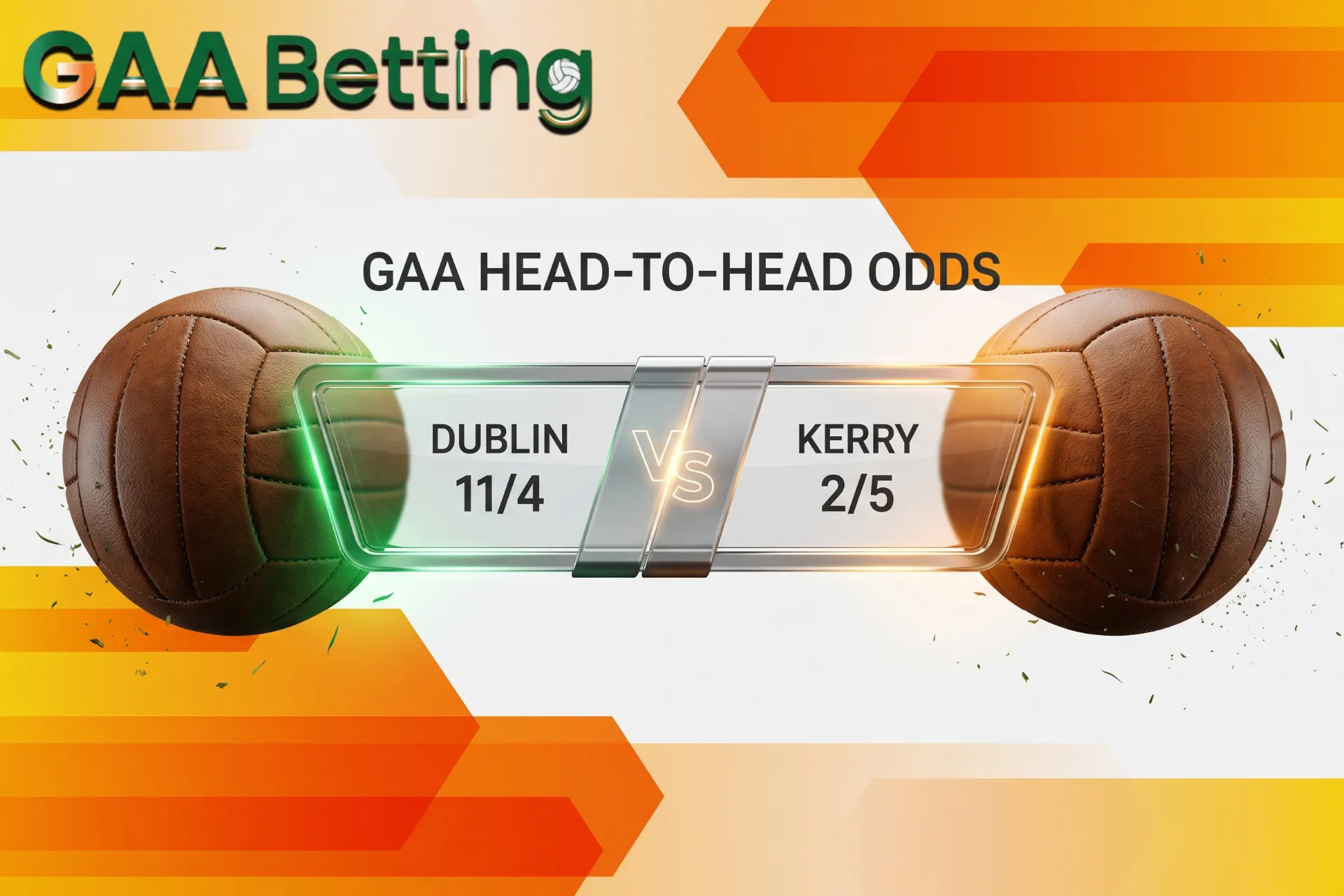
A price is an opinion about probability, adjusted so the bookmaker makes a profit. If a bookmaker rates Dublin's chance of beating a Division 2 side in a Leinster quarter-final at about 90%, the price will be short, perhaps 1/10 or 1.10, because the outcome is expected. If Dublin face Kerry in an All-Ireland semi-final and the firm sees it as close, both counties might sit near evens. That is a 50/50 market, with a small margin built in.
That is why GAA betting odds are useful even if you never place a wager. They are a constantly updated, money-backed estimate of how a match is expected to go. Pundits give opinions. Prices show where the betting money is. Learning to read them as probabilities, rather than just as payouts, is the most useful skill this guide covers.
Gaelic games have quirks that shape how odds are compiled. The playing calendar is compressed, so a county can go from the NHL or the Allianz Football League into the provincial championships within a few weeks. Squads are amateur, which means injuries, work commitments and club fixtures can affect selection in ways that rarely happen in professional sports. Scoring is high and frequent, which suits points handicaps and total points markets. Draws are possible in normal time, so a match result market is often a three-way market rather than a simple head-to-head.
Bookmakers account for these factors, but they also price GAA markets with less data than they have for the Premier League or the NFL. That gap is one reason knowledgeable Irish punters sometimes find value in GAA betting odds, particularly in lower-profile games such as club championships, the Tailteann Cup or early-round league fixtures, where odds compilers spend fewer hours on each market.
Fractional odds are the format most Irish punters grew up with. You will still see them on shop screens, in racing coverage and on many betting sites where they are the default setting. Paddy Power, BoyleSports, Ladbrokes and William Hill all display fractional prices by default for many Irish and UK customers, although each lets you switch to decimal. When people talk about GAA betting odds in the pub, they almost always quote fractions: "Kerry are 4/6", "Galway drifted out to 5/2", "the draw is 16s".
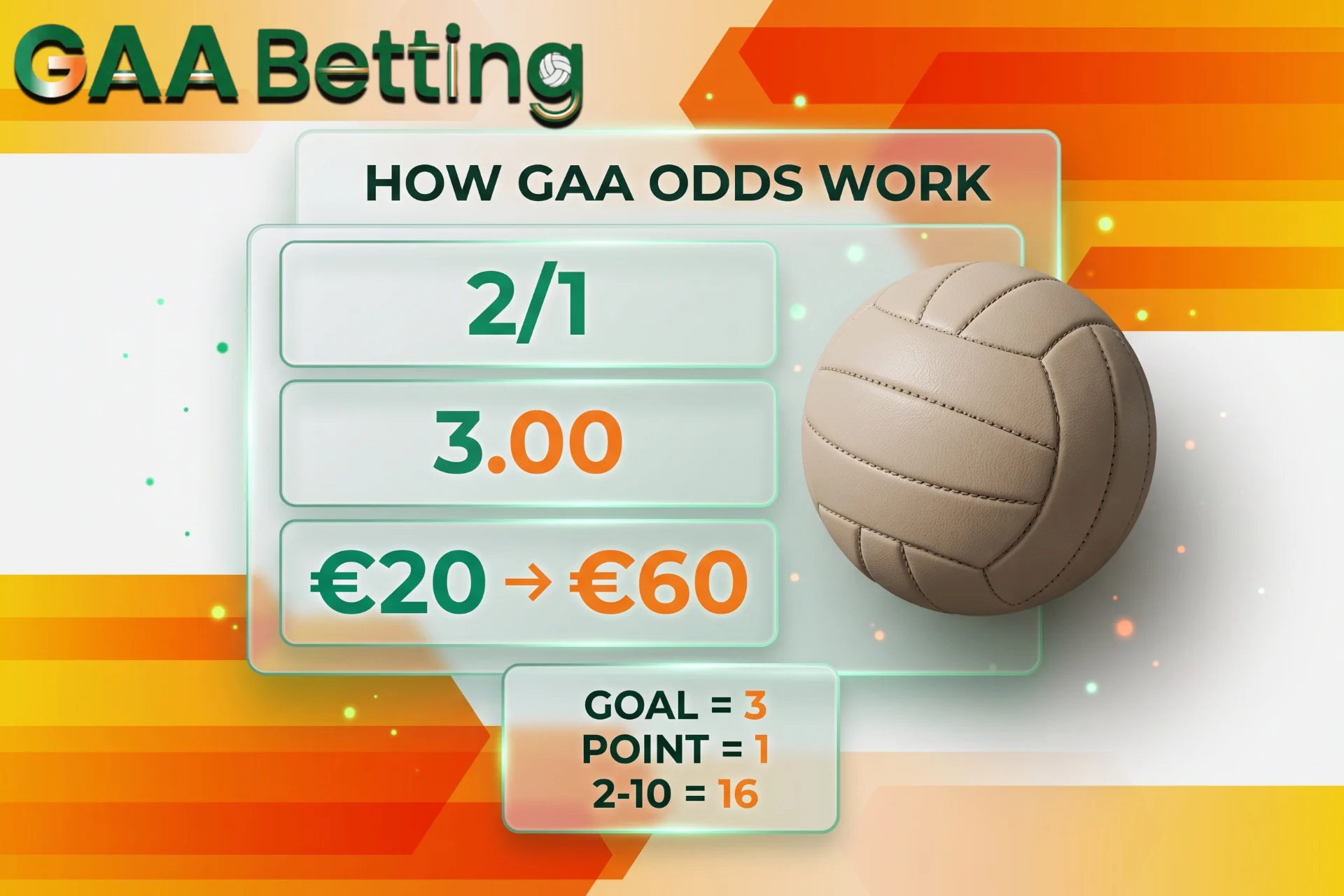
A fractional price shows profit relative to stake. The number on the right is what you stake, and the number on the left is what you win in profit. At 5/2 you win €5 profit for every €2 staked. At 1/4 you win €1 profit for every €4 staked. Your stake is returned on top of the profit when the bet wins.
The formula is simple:
Take a hypothetical Munster hurling final in which Limerick are priced at 4/7 and Cork at 7/4. A €20 bet on Cork at 7/4 returns €35 profit (20 × 7 ÷ 4) plus your €20 stake, a total of €55. A €20 bet on Limerick at 4/7 returns about €11.43 profit (20 × 4 ÷ 7) plus your stake, a total of €31.43.
Fractional prices fall into three groups, and the language is worth knowing because it comes up constantly in GAA coverage:
Some shop and newspaper conventions are worth knowing too. "Fours" usually means 4/1, "sixteens" means 16/1, and "eleven-tenths" (10/11) is a price that appears constantly in handicap and total points markets. When someone says a team is "odds-on", they mean the favourite is priced shorter than evens.
Certain fractions appear again and again in Gaelic markets. In a two-way handicap or total points market, both sides are often priced at 10/11 or 5/6. In close championship matches the favourite might be 8/11 or 4/5, with the outsider at 6/4 or 13/8. The draw in a tight football match often trades between 12/1 and 16/1, drifting much longer in one-sided games. Outright markets for the All-Ireland can run from short prices such as 6/4 for the leading contenders out to 250/1 or longer for counties outside the top tier.
One drawback of fractional odds is that awkward fractions such as 8/13, 15/8 or 30/100 are harder to compare quickly. Is 8/13 better or worse than 4/7? It is slightly better, but most people need a moment to work it out. That is the main reason many punters who compare prices across several bookmakers prefer the decimal format.
Despite that drawback, fractional GAA betting odds remain popular for good reasons. They are the traditional language of Irish betting, they are how prices are discussed on radio and in print, and they show profit at a glance. If you are used to thinking "I put on a tenner and win thirty", fractions match that way of thinking. They also make it easy to see whether a price is odds-on or odds-against, because the bigger number is either on top or underneath.
Fractions also come from horse racing, which shares the same shop screens and betting apps as Gaelic games. Punters who study racecards on a raceday at Leopardstown, or follow the Irish runners at Royal Ascot, read prices like 11/4 and 100/30 without a second thought. Ireland's deep bloodstock tradition means racing has shaped the country's betting language more than any other sport. If you can read a racing price, you can read GAA betting odds in fractional form, because the maths is identical. The only difference is that a Gaelic match has two or three outcomes rather than a full field of runners.
Decimal odds have become the standard on betting exchanges, comparison tools and many mobile apps. They are common across continental Europe and Australia, and they are increasingly used by Irish punters who bet on their phones. Every major bookmaker serving Ireland, including bet365, Paddy Power, BoyleSports, Ladbrokes and William Hill, lets you display decimal prices instead of fractions.
A decimal price shows the total return for every €1 staked, including the stake itself. The calculation is a single multiplication:
Using the same hypothetical Munster final, Limerick at 4/7 converts to roughly 1.57 and Cork at 7/4 converts to 2.75. A €20 bet on Cork at 2.75 returns €55 (20 × 2.75), which includes your €20 stake. A €20 bet on Limerick at 1.57 returns about €31.40. The figures match the fractional calculations because they are the same prices in a different format.
The key thing to remember is that decimal odds include the stake. A price of 2.00 is evens: stake €10, get €20 back, of which €10 is profit. Any price below 2.00 is odds-on and any price above 2.00 is odds-against. A decimal price can never be lower than 1.00, because that would mean getting back less than your stake when you win.
The main advantage of decimal GAA betting odds is that comparison is instant. Higher is always better for the punter. If one bookmaker offers Mayo at 3.20 and another at 3.40, you can see the better price immediately, with no need to compare 11/5 against 12/5. This matters most when you are comparing prices across several sites or using an odds tracker that lists every bookmaker side by side.
Decimals also make accumulators easier to calculate. To find the combined price of a multiple, multiply the decimal odds of each selection together. A treble of 1.50, 1.80 and 2.10 has combined odds of 1.50 × 1.80 × 2.10 = 5.67. Doing the same with 1/2, 4/5 and 11/10 is possible, but it is slower and easier to get wrong.
Decimal odds also make it simple to work out the implied probability, which is the chance of an outcome according to the price. Divide 1 by the decimal odds and multiply by 100:
Thinking in percentages helps you judge whether a price is fair. If you believe a team has a 40% chance of winning and they are available at 3.00, which implies 33.3%, the price is bigger than your estimate suggests it should be. That gap is what experienced punters mean by "value". We cover this in more detail in the conversion section below.
Most bookmakers place the odds format setting under "Preferences", "Settings" or "My Account", and it usually takes a couple of taps on a mobile app. Your choice normally applies across every sport, so GAA, soccer, rugby and other markets will all show in your preferred format. If you bet with more than one firm, it makes sense to use the same format everywhere so you are always comparing like with like.
Moneyline odds, also called American odds, are less common in Irish betting, but they turn up more often than you might expect. Some international bookmakers, bet365 among them, offer American odds as a display option. Stats sites, US-based betting media and some odds comparison tools quote moneylines by default. If you follow a GAA game on an international feed, or one of the exhibition fixtures played abroad, you may see prices written as −250 or +180. Knowing how to read them means you won't be caught out.
Moneyline odds use a baseline of 100 and come with either a plus or a minus sign:
Take the hypothetical Munster final again. Limerick at 4/7 (1.57) would be roughly −175 on a moneyline, and Cork at 7/4 (2.75) would be +175. The draw at 14/1 (15.00) becomes +1400. The signs make the favourite and the underdog obvious at a glance, which is the format's main strength.
For positive moneylines:
For negative moneylines:
So a €30 bet at +250 returns €75 profit (30 × 2.5) and €105 in total. A €30 bet at −150 returns €20 profit (30 × 100 ÷ 150) and €50 in total.
Most Irish punters will never need to bet using moneylines, but the format has practical uses. Some statistics and modelling resources publish expected outcomes in American format, especially those built with US sports in mind. If you use a betting model, a spreadsheet or a third-party tool to rate games, you may need to convert moneylines into the fractional or decimal GAA betting odds your bookmaker displays. Recognising the format also stops you misreading a price. A punter who sees "+300" and assumes it means 300 to 1, rather than 3/1, will badly misjudge the bet.
Some punters also find moneylines easier for odds-on favourites. A price of −400 makes it clear that you are risking four times what you stand to win, which can be a useful reality check before backing a heavy favourite in a lopsided provincial game.
Being able to move between fractional, decimal and moneyline prices is useful, but the real benefit comes from converting all three into implied probability. Once a price becomes a percentage, you can see how likely the bookmaker rates an outcome, compare it with your own view and measure how much margin is built into a market. This section shows how to do it, with a reference table you can come back to.
| Fractional | Decimal | Moneyline | Implied probability | Typical GAA context |
|---|---|---|---|---|
| 1/5 | 1.20 | −500 | 83.3% | Strong favourite in a provincial mismatch |
| 1/3 | 1.33 | −300 | 75.0% | Clear favourite at home in the league |
| 1/2 | 1.50 | −200 | 66.7% | Favourite in a championship quarter-final |
| 4/6 | 1.67 | −150 | 60.0% | Narrow favourite in a big derby |
| 4/5 | 1.80 | −125 | 55.6% | Slight favourite in a close game |
| 10/11 | 1.91 | −110 | 52.4% | Standard handicap or total points price |
| 1/1 (Evens) | 2.00 | +100 | 50.0% | Genuine toss-up |
| 6/4 | 2.50 | +150 | 40.0% | Live outsider in a final |
| 2/1 | 3.00 | +200 | 33.3% | Underdog with a realistic chance |
| 5/2 | 3.50 | +250 | 28.6% | Clear outsider |
| 3/1 | 4.00 | +300 | 25.0% | Leading contender in the All-Ireland outright market |
| 9/2 | 5.50 | +450 | 18.2% | Big underdog in a semi-final |
| 7/1 | 8.00 | +700 | 12.5% | Long-shot match result |
| 16/1 | 17.00 | +1600 | 5.9% | Draw in a tight football match |
If bookmakers priced every market at true probability, the implied percentages of all outcomes would add up to exactly 100%. In practice they add up to more. The excess is known as the overround or margin, and it is how the bookmaker builds in its profit.
Back to our hypothetical Munster final:
The total is 106.7%, so the market carries a margin of roughly 6.7%. The lower that figure, the better the overall value for punters. Two-way markets such as handicaps priced at 10/11 each side add up to 104.8%, which is a fairly standard margin. Outright markets with a dozen or more counties often carry much higher overrounds, sometimes 20% or more, because the bookmaker is taking on more uncertainty.
Comparing overrounds is one of the best ways to judge which bookmaker offers the best GAA betting odds for a particular fixture. A firm whose three-way market totals 104% is, on average, giving you better prices than one at 109%, even if it isn't the best price on every single outcome.
Value exists when your estimate of an outcome's probability is higher than the probability implied by the price. If your analysis gives Galway a 45% chance in a Connacht final and they are available at 5/2 (3.50, implying 28.6%), you have identified what you believe is a value bet. If you think they have a 25% chance, the same price offers no value, however tempting a big number looks.
Nobody's probability estimates are perfect, and bookmakers employ skilled compilers. The point is not that you will always be right. The point is that thinking in percentages leads to better decisions over time than backing a price because it "feels" generous. When you convert GAA betting odds into percentages as a habit, you start to see quickly which prices look short and which look generous.
Knowing the formats is the first step. The second is understanding how odds behave across the different market types offered on Gaelic football and hurling. Each market has its own logic, typical price ranges and things to watch out for. The table below summarises the main ones, followed by more detail on each.
| Bet type | What you're betting on | Typical price range | Key pricing factors |
|---|---|---|---|
| Match result (three-way) | Home, draw or away after normal time | Draw usually 10/1 to 25/1 | Team strength, venue, scoring rate |
| Handicap | Result after a points start is applied | Mostly 10/11 or 5/6 each side | Expected winning margin |
| Total points | Combined score over or under a line | Mostly 10/11 or 5/6 each side | Scoring rules, weather, team style |
| Outright | Winner of a competition | From short odds-on to 500/1+ | Draw route, depth, form |
| Player bets | Top scorer, first scorer, goals | Often 5/1 to 25/1 | Free-taking duties, minutes played |
| In-play | Any bet during the game | Changes constantly | Score, time remaining, momentum, red cards |
The standard match betting market in GAA usually has three outcomes because draws can happen after 70 minutes. Most bookmakers settle this market on normal time plus stoppage time only, so extra time, penalties or free-taking shoot-outs do not count. If you want to back a team to progress regardless of how the game finishes, look for a "to qualify" or "to lift the trophy" market, which is priced differently because it includes every possible route to victory.
The draw price is a good guide to how close the bookmaker expects the game to be. In a tight football match between two evenly matched counties, the draw might be 12/1 or 14/1. In a hurling game, where scores are more frequent and draws are slightly less common, the same match-up might see the draw at 16/1 or longer. In a one-sided fixture, the draw can drift to 33/1 or more.
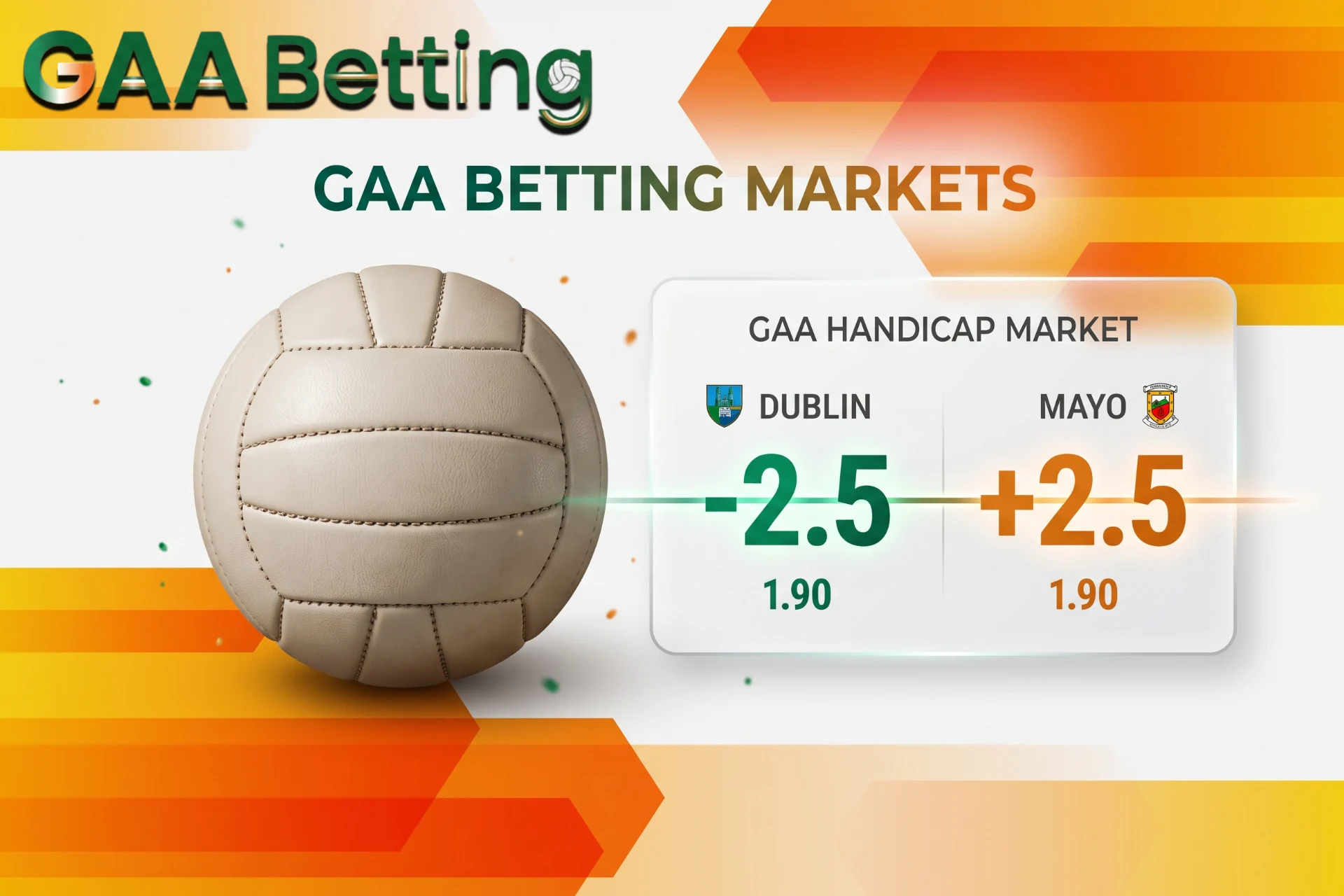
Handicap markets are the heart of GAA betting. Many championship matches are lopsided enough that the match result price for the favourite is too short to interest most punters. A handicap gives the underdog a points start, so a match where Dublin are 1/8 to win might become Dublin −7 at 10/11 against their opponents +7 at 10/11.
Some bookmakers offer a two-way handicap, where a half-point line such as −6.5 means there can be no tie. Others offer a three-way handicap with a separate price for the handicap tie, often around 8/1 to 10/1. Always check which version you're betting on. A punter who backs −7 in a three-way market loses if the favourite wins by exactly seven, while in some two-way versions the stake would be returned.
Handicap lines are set where the compiler expects roughly equal money on both sides, and they move as bets arrive. A line that shifts from −5 to −7 during the week tells you the market has come round to the favourite. That might reflect team news, informed money or simply public enthusiasm for a big name.
Total points markets ask whether the combined score will finish over or under a set line. A goal counts as three points when calculating totals, so 2-15 is 21 points. Lines are usually priced at 10/11 or 5/6 on each side, with alternative lines at different prices for those who want more or less risk.
Football totals changed significantly with the playing-rule changes introduced in 2025, including a two-point score for kicks from outside the 40-metre arc. The new arc scores pushed scoring up, and bookmakers had to adjust their total points lines. Early in that transition, punters who followed the actual scoring trends from week to week were well placed to spot lines that hadn't fully caught up. Whenever rules change, expect a period where totals markets lag behind what is happening on the pitch.
Weather also plays a big role. A wet, windy evening in a provincial ground can take several points off a hurling or football total, and lines often move in the final hours before throw-in as forecasts firm up.
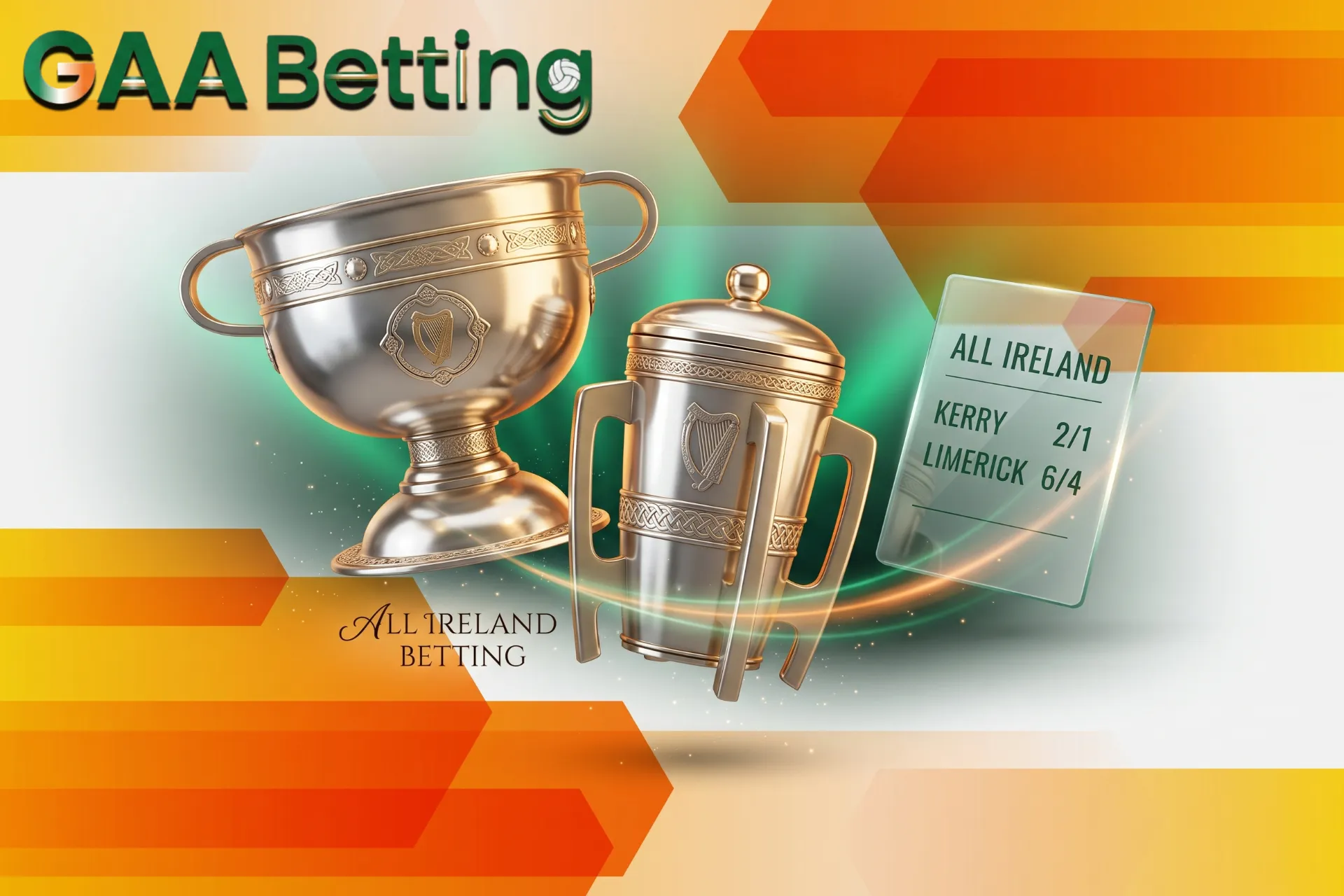
Outright markets cover competition winners: the Sam Maguire, the Liam MacCarthy, the provincial championships, the NHL and Allianz Football League divisions, and in some cases the Tailteann Cup and club championships. These markets open months in advance and move throughout the season.
Outright GAA betting odds are shaped by more than team strength. The structure of the competition matters. A county that avoids the strongest sides until a later stage of the race for Sam may be shorter than its raw ability suggests, while a strong team facing a difficult provincial route might be bigger than expected. League form gives clues, but Irish punters know that some counties use the league to experiment and peak for the championship, so a disappointing league campaign is not always a warning sign.
Each-way terms sometimes apply to outright markets, paying a fraction of the odds if your selection reaches the final or semi-final. Check the terms carefully, as they vary between bookmakers and competitions.
Player markets have grown quickly in GAA. You can typically bet on the top scorer, first scorer, anytime goalscorer and, in some cases, the number of points a named player will score. Free-takers dominate top-scorer markets because placed balls make up a large share of the scoring, so knowing who will be on frees, and from which side of the pitch, is valuable information. A player listed in the starting team but expected to be withdrawn early is priced very differently from one who will play the full 70 minutes.
Same game multiples, often branded as "bet builders", let you combine several selections from the same match, such as a handicap, a total points line and a top scorer. Because these outcomes are related, bookmakers adjust the combined price rather than simply multiplying the individual odds. The margin in same game products tends to be higher than in single markets, which is worth remembering if you use them regularly.
Live odds update with every score, wide and substitution. Hurling markets move especially fast because scores come so often. In-play betting can offer opportunities when you're watching closely and you think the market has overreacted to an early goal or a sending-off, but decisions have to be made quickly. Most bookmakers do not stream GAA themselves because broadcast rights sit with RTÉ, TG4, Sky Sports and the GAA's own GAAGO streaming service, so you will usually watch on one platform and bet on another. A delay between the live picture and the betting feed is normal, which is one reason bookmakers suspend markets briefly when play is dangerous.
The best GAA punters combine an understanding of odds with solid form study. Useful statistics include scoring averages, shot conversion rates, kick-out retention in football, puck-out success in hurling, wides per game and the share of scores coming from frees. Head-to-head records matter less than recent form, because panels change from year to year, but venue and travel can affect results, especially for counties playing outside their province.
Team news is often the biggest single factor in how a price moves. Inter-county teams are announced a day or two before throw-in, and late changes on match day are common. A key forward ruled out can move a handicap line by a point or more within hours. Punters who follow county boards, local newspaper coverage and digital outlets closely often see these shifts before the wider market does. Free tips are widely available online and can be a useful starting point, but treat them as one opinion to test against your own reading of the probabilities rather than as a shortcut.
Price comparison is the simplest way to improve your returns over time. Even small differences add up. Regularly getting 2.75 instead of 2.60 is worth more to a regular punter than most bonuses. The major bookmakers serving Irish customers all cover Gaelic games, but they differ in market depth, display options and extra features.
| Bookmaker | Default odds format (IE) | Alternative formats | GAA coverage | Worth noting |
|---|---|---|---|---|
| Paddy Power | Fractional | Decimal | Extensive inter-county and club markets | Irish-founded brand with regular GAA price boosts and specials |
| BoyleSports | Fractional | Decimal | Strong championship, league and club depth | Irish-owned, with a large retail presence alongside online betting |
| bet365 | Fractional | Decimal, American | Wide pre-match and in-play range | One of the few major firms offering moneyline display; strong in-play tools |
| Ladbrokes | Fractional | Decimal | Solid coverage of major inter-county fixtures | Long-established brand; check for GAA-specific promotions |
| William Hill | Fractional | Decimal | Good coverage of championship and league | Large international operator with a wide range of specials |
Features, promotions and market ranges change regularly, so check each site directly before relying on any one firm for a particular fixture. It is also common for one bookmaker to lead on a handicap line while another is better on outrights. That's why many experienced punters hold accounts with several firms.
The gap between firms tends to be widest on lower-profile fixtures, such as early-round league games or club championships. Compilers price these GAA betting odds with less data and spend fewer hours on each market, so shopping around often pays off most here.
Anyone betting from Ireland should use a properly licensed operator. Online bookmakers serving Irish customers have historically needed a remote bookmaker's licence issued through the Revenue Commissioners, and every bet placed in the State carries betting duty. The Gambling Regulation Act 2024 established the Gambling Regulatory Authority of Ireland (GRAI), a dedicated regulator that is taking over licensing and supervision as the new regime is phased in. The framework brings tighter rules on advertising, inducements and customer protection, including a national self-exclusion register.
Before opening an account, check that the bookmaker displays its Irish licence details clearly, usually in the website footer. Licensed operators must verify your age and identity, and Irish betting is strictly for those aged 18 and over. Unlicensed offshore sites may advertise bigger prices, but you have little protection if a dispute arises or winnings are withheld.
Understanding odds can make you a more informed punter, but it does not remove the risk. Bookmakers build a margin into every market, and most people who bet regularly lose money over time. Treat betting on Gaelic games as entertainment with a cost, not a way to earn money.
If gambling is causing problems for you or someone close to you, confidential support is available in Ireland through organisations such as Problem Gambling Ireland, Gamblers Anonymous Ireland and the HSE's addiction services. Asking for help early makes a real difference.
No format gives you a better price. A fractional, decimal or moneyline price is the same bet shown in a different way. Most Irish punters who bet on apps find decimal odds easiest because higher always means better and accumulator returns are simple to calculate. If you have always used fractions and find them intuitive, there's no need to change. What matters is using the same format consistently across every bookmaker so your comparisons are accurate.
With decimal odds, multiply your stake by the price to get your total return, including your stake. €10 at 3.25 returns €32.50. With fractional odds, multiply your stake by the fraction to get profit, then add your stake. €10 at 9/4 gives €22.50 profit plus €10, so €32.50 in total. With moneylines, positive numbers show profit per 100 staked and negative numbers show how much you must stake to win 100. Most betting slips also show your potential return automatically before you confirm the bet.
In most match result markets, no. Bookmakers usually settle standard GAA betting odds on normal time, meaning 70 minutes plus stoppage time for senior inter-county games. If the match is level at that point, the draw wins, even if one team goes on to win in extra time or a shoot-out. To back a team regardless of how the game ends, use a "to qualify" or "to win the trophy" market. Always check the specific settlement rules on your bookmaker's site, as they can vary.
Gaelic football and hurling are high-scoring games with many individual scores, so the chance of both teams finishing on exactly the same total is relatively small. In a closely matched football game, the draw might be 12/1 to 16/1, which implies roughly 6% to 8%. In hurling, where scores come even more frequently, draws tend to be slightly less likely. In one-sided fixtures, the draw becomes a very long price because a level finish requires the underdog to perform well above expectations.
When a price shortens, for example from 5/2 to 7/4, the bookmaker now rates that outcome as more likely, often because money has come in for it or because of positive team news. When a price drifts, for example from 2/1 to 3/1, the outcome is seen as less likely or has attracted little support. Late moves in the hours before throw-in frequently follow team announcements. Tracking these movements helps you understand how the market's view is changing, but a shortening price is not a guarantee of anything.
Yes. Prices differ between firms, sometimes by a lot on the same market. One bookmaker might offer the best price on a handicap while another leads on the outright or a player market. Comparing GAA betting odds at Paddy Power, BoyleSports, bet365, Ladbrokes, William Hill and other licensed operators before each bet is one of the simplest ways to improve your long-term returns. Looking at the overall margin in a market, not just a single price, also shows which firm is generally offering the fairest odds.
Paddy Power: Bet €5 get €40 on GAA
Claim NowBoyleSports is offering new customers Bet €10 get €40. Compare the price, then lock in your selection.
Get the Offer